
March 3, 2026 Total Lunar Eclipse Livestream
Watch the SolarSTEAM livestreams of the March 3, 2026 total lunar eclipse. Anchored at Southern Illinois University Carbondale, the livestreams will include views from SolarSTEAM and DEB Initiative volunteer telescopes at 3 locations in North America including Carbondale, Illinois, Trinidad, Colorado, and Salem, Oregon. This is the last total lunar eclipse visible from the US until December 2028. Don’t miss it! You can watch all the livestreams right here or directly on YouTube live on the following channels:
@NASASolarSTEAM: Wide and narrow field lunar eclipse views from SIU Carbondale. This site will see the first phases of the total solar eclipse. The Moon will set below the horizon and the Sun will rise prior to the final partial phase of the eclipse completing.
@NASASolarSTEAM2: Deep Sky Imagery from SIU Carbondale. There is more in the sky than just the Moon this evening. This second channel will have live stacked images from a second 100mm telescope showing galaxies, nebula and star clusters throughout the evening.
@TotalityTown: Lunar eclipse images from DEB Initiative team #02 in Trinidad, Colorado. This site will see all phases of the total solar eclipse.
@NASASolarSTEAM3: Lunar eclipse images from DEB Initiative team #22 in Salem, Oregon using a 94mm telescope. This site will see all phases of the total solar eclipse.
Schedule
3:30AM CST / 9:30AM GMT: The broadcast begins with a message from Southern Illinois University Carbondale giving an overview of what to expect to see this evening on the main @NASASolarSTEAM channel. Secondary channels begin streaming clean telescope feeds. At this time, the lunar eclipse is already in progress with the start of the penumbral phase. This phase is barely noticeable as a slight dimming of the Moon as the penumbral shadow of the Earth is cast upon it. Throughout the evening, the deep sky imaging telescope will change target approximately every 15 minutes.
Lunar Eclipse Timing:
3:50AM CST: U1 (start of partial phase). The darker umbral shadow of the Earth casts a dark crescent shaped shadow on the Moon.
5:04AM CST: U2 (start of totality). The Moon will turn a shade of deep orange or maroon as the Earth’s shadow covers it completely The shade of the color of the Moon is determined by the atmospheric composition of the Earth’s atmosphere.
6:02AM CST: U3 (end of totality). As the Earth’s shadow moves off the Moon, the partial phase progresses in reverse.
6:29 CST: Sunrise in Carbondale, Illinois
7:17 AM CST: U4 (3nd of partial phase). The Earth’s shadow moves off the Moon and it once again appears as a full Moon.
When will the broadcasts end? The broadcast on each channel will end when the eclipse is over or we can no longer image due to the Moon setting / Sun rising. We expect the deep sky imaging will have to come to an end about 3 minutes prior to sunrise in Carbondale. The last location to see the eclipse in the final partial phase will be Trinidad, Colorado.
See the eclipse in person
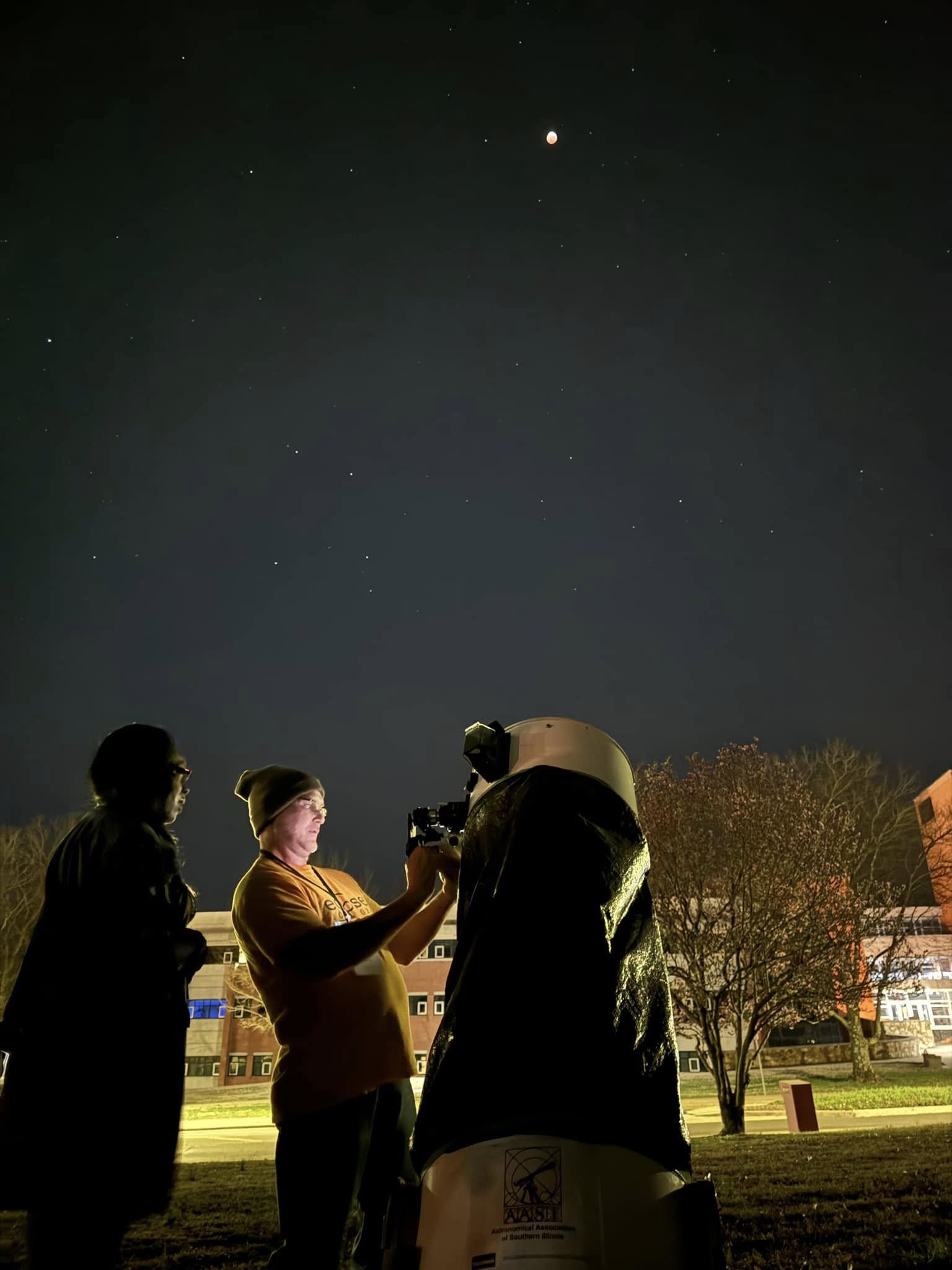
Portions of the March 3, 2026 total lunar eclipse are visible from North and South America, Australia and Asia. The eastern US will see the start of this eclipse with the midwest and western US viewing all of totality. For more information on this eclipse and to see if it is visible in your area, see the NASA eclipse webpage. Livestreaming on the main @NASASolarSTEAM channel will originate from the free public eclipse observation at Southern Illinois University in Carbondale, Illinois.