
12 August 2026 Total Solar Eclipse Live from Leon, Spain
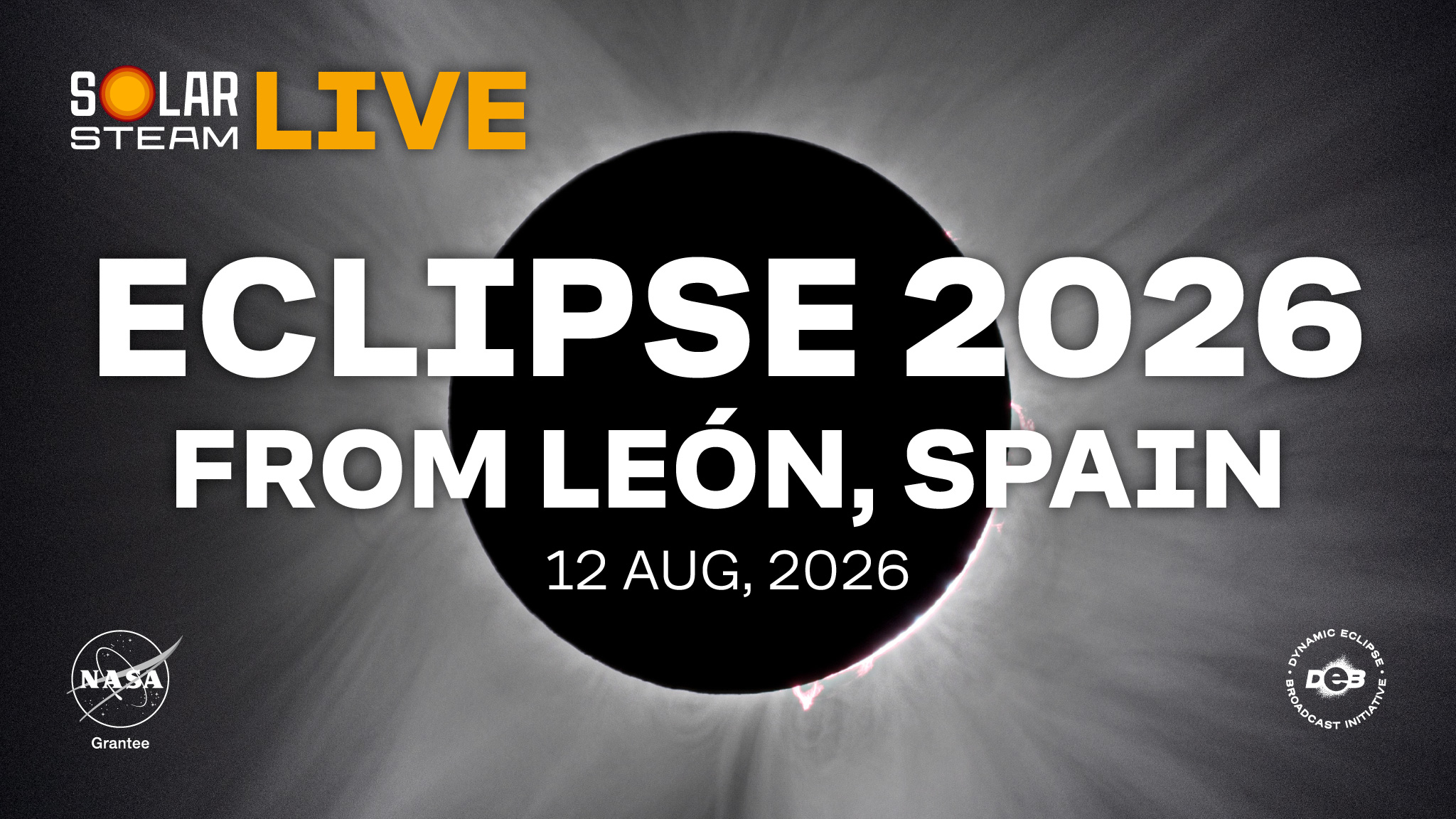
Watch the SolarSTEAM livestreams of the 12 August 2026 total lunar eclipse live from Leon, Spain. The livestreams will include views from SolarSTEAM and DEB Initiative volunteer telescopes at 2 locations including Leon and Valoria le Buena, Spain. The first total solar eclipse in Europe since 1999, this eclipse precedes the “eclipse of the century” coming up in 2027. You can watch all the directly on YouTube live on the following channels:
@NASASolarSTEAM: Eclipse 2026 Live from Leon, Spain. Hosted by SIU Carbondale School of Media Arts student, Annalise Gould. Beginning at 12:15pm CDT / 7:15pm CEST, the program will feature live and prerecorded interviews as well as multi-wavelength telescope feeds in full color white light, Hydrogen Alpha and Cacium-K. This collaborative production between SIU Schools of Media Arts, Physics and Applied Physics and the STEAM Education Research Center will give a a front seat view to the eclipse, solar activities, and also take you behind the scenes to meet the students, faculty and staff working to bring you this incredible event. Telescope feeds from @NASASolarSTEAM sub-channels will be featured throughout the program. The program will end at 13:55pm CDT / 8:55pm CEST as the last partial phase draws to an end while the sun is setting in Leon, Spain.
Dedicated telescope feeds on the following @NASAsolarSTEAM sub-channels
@NASASolarSTEAM2: Full color white light 100 mm solar telescope feed. A dedicated feed to watch the total solar eclipse though all phases from start to finish.
@NASASolarSTEAM3: False color Hydrogen-Alpha telescope feed will show high detail of the solar surface including prominence during the partial phases of this eclipse. This Lunt Solar Systems 100mm telescope uses an ultra-narrow band filter to look at red light from the sun coming from the Hydrogen spectra.
@NASASolarSTEAM4: False color Calcium-K telescope feed will show high detail of the solar surface including prominence during the partial phases of this eclipse. This Lunt Solar Systems 100mm telescope uses an ultra-narrow band filter to look at violet light from the sun coming from the Calcium spectra.
@NASASolarSTEAM5: White light color feed from Dynamic Eclipse Broadcast Initiative observation team #89 located in Valoria le Buena, Spain. The 40mm DEB Initiative solar telescope will provide images of the solar surface during the partial phases and the solar coronal during totality.
Schedule
12:15 CDT / 19:15 CEST: Program and all telescope feeds begin.
Total Solar Eclipse Timing in Leon, Spain:
12:32:45 CDT / 19:32:45 CEST: C1 (start of partial phase). You can first see the Moon begin to block the sun at this time in Leon. Note, you must wear eclipse glasses at any time when looking at directly at the Sun.
13:28:20 CDT / 20:32:45 CEST: C2 (beginning of totality). Totality begins after the last bit of direct light from the Sun is blocked by the Moon. For observers in the path of totality, a diamond ring effect lasting a few seconds will precede totality. Once the entire solar surface is blocked, the solar corona will appear as well as red prominences extending outward. At this time it is safe to remove your solar glasses and view the corona directly since all direct light from the Sun is blocked by the Moon.
13:30:05 CDT / 20:30:05 CEST: C3 (end of totality). A second diamond ring appears as the direct sunlight is once again visible. At this time, the corona is no longer visible and you must wear eclipse glasses to look at the remainder of the partial phase of the eclipse.
14:22:04 CDT / 21:22:07 CEST: C3 (end of the last partial phase). Just before the sun sets in Leon, Spain, the last partial phase of the eclipse ends. Note that it is estimated that we will loose our view of the eclipse in Leon, Spain around 13:50 CDT / 20:50 CEST.
14:29 CDT / 21:29 CEST: Sunset in Leon, Spain.
When will the broadcasts end? The broadcast on each channel will end when the eclipse is over or we can no longer image due to the Sun, around 13:55pm CST / 20:55 CEST.
See the eclipse in person
Portions of Greenland, Iceland and Europe will witness this eclipse. See a detailed map of the eclipse path here: Xavier Jubier 2026 TSE Map
When is the next one?
On 2 August, 2027, a historic long duration total solar eclipse will sweep across the North Africa and Middle East regions plunging portions of 12 countries into darkness for up to 6 minutes and 23 seconds. Southern Illinois University is working with partners to plan an, “eclipse of the century,” livestream from Morocco. The livestream will include telescope feeds from local volunteer teams along the path of totality participating in the Dynamic Eclipse Broadcast (DEB) Initiative. If you would like to be involved in citizen science observations during the 2027 eclipse, see the DEB Initiative’s website for more information: https://debinitiative.org/main/tse-27/